
In film and television, music does more than fill silence. It shapes emotion, narrative rhythm, and even the perceived realism of a scene. Yet not all music functions in the same way. Professionals often distinguish between source music (diegetic music) and dramatic music (non-diegetic music). Knowing the difference isn’t just about theory. It directly affects how music is licensed, credited, and paid for through PROs.
1. Diegetic Music: Source Music
What Does “Diegetic” Mean?
The term diegetic comes from the Greek διήγησις (diegesis), meaning “narrative” or “storytelling.” In cinematic terms, diegetic music (also called source music) is music that exists within the film’s story world.
In simple terms: diegetic music is music the characters can actually hear.
Real World Examples
Think about the following scenes: A band playing at a wedding in the scene? Diegetic. A song blasting from a car radio? Diegetic. That painfully awkward karaoke scene in My Best Friend’s Wedding? Totally diegetic.
The characters are experiencing this music in their world. It’s part of their reality. And just because it’s “in the scene” doesn’t mean it was actually recorded live on set. Most of the time, productions clean it up or replace it entirely in post-production. But the key is: it feels like it belongs in that moment, in that space.
2. Non-Diegetic Music: The Dramatic Score
By contrast, non-diegetic music refers to everything added for the audience’s benefit, outside the story world. The characters don’t hear it, but the audience does. This is your classic film score territory:
- That sweeping orchestral theme when the hero saves the day
- The romantic piece when the couple is holding hands on the beach at sunset
- The creepy strings building tension in a horror film The emotional piano cue that makes you cry even though nobody’s saying anything
Think of the Star Wars theme. Those characters aren’t hearing John Williams’ iconic score, but we sure are, and it’s doing a ton of heavy lifting to make us feel epic and adventurous.
Non-diegetic music is one of your most powerful tools as a composer. It tells the audience how to feel, when to lean in, when to relax. The characters are clueless, but you’re guiding the viewer’s entire emotional journey.
3. Trans-Diegetic: When Lines Get Blurry
Some of the coolest moments in film happen when directors mess with these boundaries. It’s called trans-diegetic sound, and it’s basically when music shifts from one world to the other.
The viewer assumes it’s just score, music for us, the audience. But then the camera moves, and you realize it’s actually coming from a car radio. Suddenly it’s diegetic. That little trick pulls you deeper into the scene without you even realizing it.
Example: Once Upon a Time in Hollywood
A great example is Jose Feliciano’s version of “California Dreamin'” in Once Upon a Time in Hollywood. The song starts as non-diegetic score, playing over scenes of the female protagonist, then continues as we follow Brad Pitt’s character driving through Los Angeles. The whole time, you’re absorbing it as cinematic underscore. But then Pitt reaches over and turns off his car radio, and suddenly you realize the music was diegetic the entire time. It’s coming from his car. That reveal reframes everything you just watched and heard, pulling you deeper into the reality of the scene.
4. Why This Matters for Your Music
Let’s’not just throwing film theory around for fun. This stuff has real implications:
Diegetic music makes scenes feel authentic. It grounds the story in a specific time, place, or vibe. Think of every Tarantino needle-drop or that perfect song playing at a party in a rom-com.
Non-diegetic music controls the emotional temperature of the whole project. It’s how you build tension, release it, make people laugh or cry. It’s the backbone of the viewing experience.
Trans-diegetic techniques let you play with perspective, pulling viewers in and out of the story world seamlessly. As a composer or music supervisor, knowing when to use each type helps you communicate better with directors.
When should the music feel “real”? When should it be invisible? When should it blur the line? These are the conversations that lead to great creative work.
5. The Money Talk: Licensing and Rights
Alright, here’s where it gets practical. The difference between source and score isn’t just creative, it affects your contracts and your wallet.
Source Music (Diegetic):
Source music typically involves using existing songs, whether it’s a classic rock tune, an indie track, or a well-known pop hit. This means clearing both master and publishing rights, which can get expensive fast, especially for recognizable tracks. That’s why so many productions turn to libraries like After Sunset Music, affordable pre-cleared tracks that still sound great. If you’re composing something new specifically for a diegetic use, you’ll usually license it as a sync for on-screen performance, like a band playing at a party or a song on a character’s playlist.
Dramatic Music (Non-Diegetic) :
Dramatic music can come from two main sources:
Pre-existing tracks – In television especially, productions frequently license pre-existing songs and instrumentals to use as underscore. These tracks come from record labels, sync-focused labels, or production music libraries. Think of that perfect singer-songwriter ballad playing under an emotional scene, or an atmospheric instrumental setting the mood. The production licenses these already-finished tracks rather than commissioning new music.
Film scores – In film, dramatic music is typically created from scratch by a film composer specifically for the project. These custom-composed scores are usually done as work-for-hire, meaning the production company owns the music. The composer is hired to create original pieces tailored to each scene and the film’s overall emotional arc.
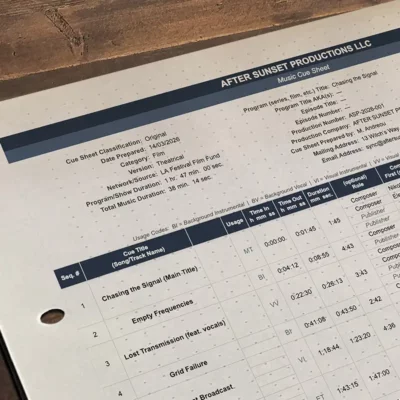
Both approaches require proper documentation through cue sheets submitted to PROs (like ASCAP, BMI, PRS) to track where and how the music is used for royalty purposes.
6. How You Get Paid: PROs and Cue Sheets
The relationship between how music is used cinematically (diegetic vs. non-diegetic) and how it’s categorized on cue sheets for royalty payments (usage codes like Background, Visual, Featured, etc.) is more nuanced than a simple one-to-one mapping. While diegetic and non-diegetic distinctions are creative concepts, cue sheet usage codes follow different rules—and understanding this indirect connection can have a real effect on your royalty payments. We’ll explore exactly how these usage codes work in our next blog post.
Final Thoughts
Diegetic, non-diegetic, trans-diegetic, yes, the terms sound fancy. But really, they’re just describing how music lives in a story: is it part of the characters’ world, or is it just for us, the audience?
This isn’t just film theory. It’s how audiences connect with stories, how productions budget for music, and how you, the creator, get paid fairly for your work.
Whether you’re composing, producing, or licensing music, understanding these layers isn’t optional. It’s how you make smarter creative choices, protect your work legally, and make sure you’re getting every dollar you’ve earned.
Want more on the business side of sync? Browse the After Sunset Music blog for more guides on licensing, royalties, and building a career in music for picture.