
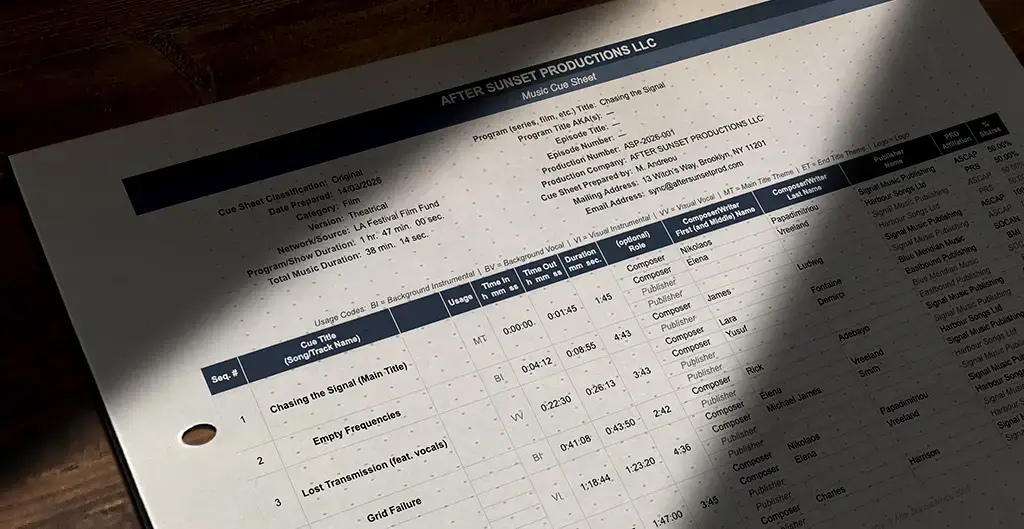
Every music cue in a film or TV production is assigned a usage code on its cue sheet—Background, Visual/Featured, Theme, or Logo. That code directly affects how much you get paid. Diegetic vs. non-diegetic is a creative distinction; the usage code is a financial one. Understanding the difference can protect your income.
In our previous post, we broke down the difference between source music (diegetic) and dramatic score (non-diegetic)—how music lives inside or outside a story’s world. Start there if you haven’t already—it’ll make this post click faster.
But here’s the thing most composers and producers don’t realize right away: those creative categories don’t directly determine your paycheck. Cue sheet usage codes do. And the relationship between the two isn’t as straightforward as you might expect.
What Are Cue Sheet Usage Codes?
Every time music is used in a film or TV production, it gets documented on a cue sheet — a detailed log that tells Performing Rights Organizations (PROs) like ASCAP, BMI, PRS, or APRA AMCOS exactly what music was used, where, and how.
Each music cue on the sheet is assigned a usage code that describes how the music functions in the production. While the terminology varies slightly between PROs, the core categories are broadly similar:
Background (BG) — Music that forms part of the overall sound design of a scene. This is the most common code. It covers underscores, mood-setting instrumentals, and any music that supports the scene without being the focal point.
Visual / Featured (VI) — Music that is performed on screen, visually represented as being heard by characters, performed in music videos, used with choreographed dance sequences, or is otherwise “on camera” and prominently featured.
Theme (TH) — Music that is regularly associated with a series, program, or film, used as its opening and/or closing music. This is a distinct category from Background, and it comes with its own payment structure.
Logo — The short musical piece that plays under a production company’s or broadcaster’s logo.
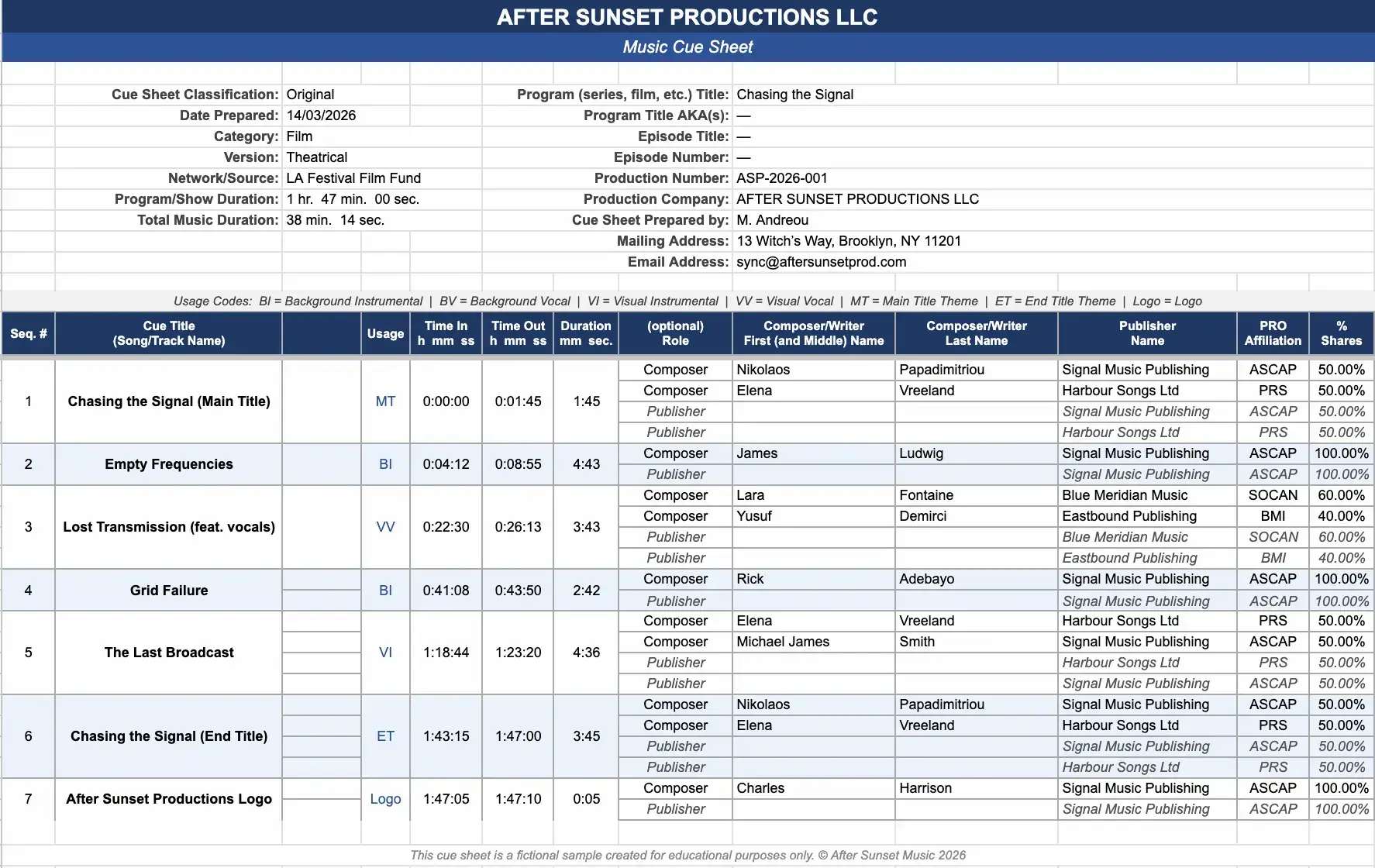
There are a few others (like Live Performance or Recap), but these four are the ones you’ll encounter most as a composer or producer working in sync.
Where It Gets Tricky: Diegetic Doesn’t Always Mean “Visual”
This is where a lot of people — understandably — get confused.
You might assume that diegetic music (source music the characters can hear) automatically equals “Visual” on a cue sheet, and that non-diegetic music (the score only the audience hears) automatically equals “Background.” It’s a logical assumption. But it doesn’t hold up in practice.
The cue sheet doesn’t care whether the music exists inside the story world. It cares about how prominently the music functions in the scene.
Let’s go back to a scenario from real life: a song playing from a radio.
Scenario A: When Diegetic Stays Background
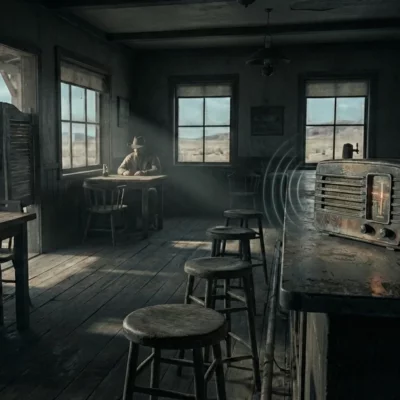
Two characters are sitting in a kitchen, having an intense conversation. A radio is on in the background, and you can faintly hear some music underneath the dialogue. It’s there, it’s diegetic — the characters could theoretically hear it — but it’s not the point of the scene. Think of Lalo Salamanca cooking in Better Call Saul while music plays from a radio in the background — it adds texture, but the dialogue is the star. On the cue sheet, this would most likely be coded as Background.
Scenario B: When Diegetic Becomes Featured
Think of “Stuck in the Middle with You” in Reservoir Dogs. That song is also coming from a radio — also diegetic. But it’s the centerpiece of the entire scene. The camera lingers on it. The character dances to it. The music drives the mood, the pacing, everything. Worth noting: a track doesn’t need to have vocals to be coded Visual/Featured. If characters are dancing to it, or if the dialogue stops and the music takes over the storytelling, it qualifies. On the cue sheet, this would be coded as Visual/Featured.
Same source. Same radio. Completely different cue sheet code. And as we’ll see, completely different payment.
Non-Diegetic Doesn’t All Pay the Same Either
You might assume that since non-diegetic music is all “just score,” it all lands in the same category. Not quite.
Scenario A: Non-Diegetic as Background
Think about the Up montage — Carl and Ellie’s entire life together, scored by Michael Giacchino, no dialogue, just music carrying the full emotional weight of the scene. The characters hear none of it. It is as non-diegetic as it gets. And yet, as devastating and unforgettable as it is, it’s Background underscore. Beautifully written, brilliantly placed — but Background nonetheless.
Scenario B: Non-Diegetic as Opening Theme
Now think about the Star Wars main theme blasting over the opening crawl. Also non-diegetic — the characters hear none of it either. But this cue functions as the opening theme of the film, and “Theme” is its own usage code, one that typically pays a higher rate per minute than Background.
Both are non-diegetic. The characters hear neither. And yet they are not the same thing on a cue sheet. That distinction matters — a cue that serves as the recurring theme of a series will be coded differently (and compensated differently) than a one-off underscore cue, even if both are non-diegetic score at their core. The emotional power of a cue doesn’t change its usage code. How the production uses it does.
Why This Matters for Your Wallet
This isn’t academic. The usage code assigned to your music on a cue sheet directly affects your royalty payments.
While the exact multipliers differ between PROs and territories, the general hierarchy looks something like this:
Theme > Visual/Featured > Background
Visual/Featured cues typically generate higher performance royalties than Background cues. Theme cues often pay the most. The differences aren’t small — we’re talking about a higher royalty rate per minute of music played, and depending on the PRO and broadcast territory, that multiplier can be significant.
So if your track is the emotional centerpiece of a scene — the song everyone remembers, the one the director built the scene around — and it’s coded as Background instead of Visual, that’s real money left on the table.
This logic extends to the sync fee as well. A production will typically pay more upfront for a track being used as a prominent needledrop than for something barely audible under dialogue. The usage type affects both ends of the equation.
What You Can Actually Do About It
Here’s the practical takeaway — and it’s one that too many composers overlook:
Check your cue sheets — Usage codes get filled in hastily by someone who wasn’t in the edit suite. A Visual cue logged as Background. A theme never flagged as Theme. It happens constantly and most composers never catch it because they never look
Speak up if something looks wrong — A prominent scene-defining placement coded as Background is worth raising with the production or your publisher. It’s your right to make sure your work is documented accurately
And if you’re a music supervisor or work in post-production: accurate cue sheet coding isn’t just paperwork. It directly affects the livelihoods of the people whose music you’re placing. Taking the extra minute to code a cue correctly is one of the most impactful things you can do for the creative community you work with.
Final Thoughts
Diegetic vs. non-diegetic tells you where music lives in a story. Cue sheet usage codes tell you how it’s valued by the industry.
The two are related, but they’re not the same thing. A diegetic cue can be Background or Visual. A non-diegetic cue can be Background or Theme. What matters isn’t where the music comes from in the story — it’s how prominently it functions in the scene and the production as a whole.
Understanding this distinction doesn’t just make you a better-informed composer. It helps you protect your income, communicate more effectively with supervisors and producers, and make sure that when your music does the heavy lifting in a scene, your cue sheet reflects it.
Further Reading
Want more on the business side of sync? Browse the After Sunset Music blog for more guides on licensing, royalties, and building a career in music for picture.