
Before we start, a quick warning. This post is going to lean heavily on a few well-worn quotes and concepts. Consider this your official Floskel Warning. We’re going to borrow wisdom from Tony Robbins on taking intentional action, Bruce Lee on mastering your craft, Seth Godin on consistency over authenticity, and the classic mantra: “Go deep rather than wide.”
These phrases get thrown around a lot in hustle culture, usually by someone telling you to post ten times a day and grind until you bleed. That’s not where this post is going. If you’re looking for a Gary Vaynerchuk-style “hustle 24/7” guide to building a composing career, you’re in the wrong place.
What I want to talk about instead is a professional, focused, relaxed approach to composing — whether you write for libraries, for film, or for your own artist project as a songwriter. The idea isn’t to burn out in 18 months. It’s to still be doing this, and enjoying it, in 20 years.
Library composers will probably recognize themselves most directly in what follows, but the mindset applies equally to film composers, singer-songwriters, and working musicians. The principles are the same; only the context changes.
1. The Numbers Game — Reframed as Patient Cultivation
Here’s the first reframe.
In library music, the big €100,000 sync placement is the exception. The rule is the opposite: 100,000 small placements that each generate around €1. Background cues in daytime TV. Corporate video beds. App notifications. YouTube ambience. Tiny uses, tiny payouts, piling up quietly over years.
This sounds unglamorous until you realize what it actually is: a long-term, compounding income stream that keeps working for you.
And here’s the important part — this isn’t about cranking out tracks on a factory line. It’s about planting a garden. You’re not trying to produce as much as possible as fast as possible. You’re building a catalog that, over time, earns you back for every hour you put into it.
That said — individual tracks absolutely can break out. Three quick examples:
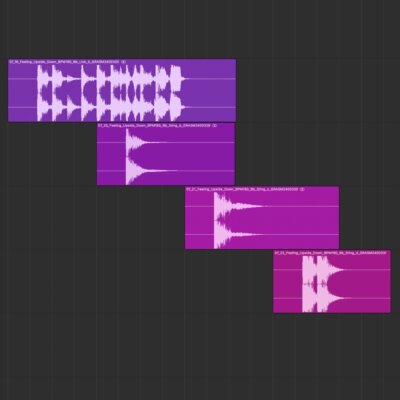
- Nicholas Pesci’s “Feeling Happy“ — an uplifting ukulele-and-whistle library cue — started gaining popularity through YouTube commercials, was then featured prominently in apps, and ultimately found a dedicated audience around the world after being used over 1M times on UGC platforms like Instagram, Facebook, TikTok, and YouTube Shorts.
- Luciano Michelini’s “Frolic“ was written in 1974 as a throwaway piece for an Italian comedy, ended up in a production music library, and sat there for decades being licensed occasionally for ads. Then Larry David happened to hear it in a bank commercial, tracked it down, and made it the theme of Curb Your Enthusiasm in 2000. Today it’s also a widely-used meme — the sound of every awkward moment on the internet, from Steve Harvey’s Miss Universe mix-up to the La La Land / Moonlight Oscar blunder.
- Christopher Field’s “Gothic Power“ — written for the X-Ray Dog Music library in 1999 — landed in a Lord of the Rings trailer and effectively launched his career as a trailer composer.
The point isn’t to chase virality. The point is: if you keep planting, some seeds grow into surprisingly big trees. You just can’t predict which ones in advance — which is exactly why you keep planting.
2. Don’t Put All Your Eggs in One Basket — Work With Multiple Libraries
If the first principle is keep planting, the second is plant in multiple gardens.
Think carefully before signing your entire catalog exclusive to a single library. Some exclusive deals are excellent — top-tier libraries like Extreme Music or Universal Production Music offer advances, dedicated pitching, and placement access that non-exclusive libraries rarely match. But putting everything with one company, no matter how good, concentrates risk. Research what’s out there. Every library has its own personality: its own sound, its own clients, its own strength areas. One specializes in trailer music. Another focuses on corporate and advertising. Another is known for cinematic orchestral work. Another lives in the podcast and UGC space.
Your job is to understand where your catalog actually fits. A few things to look for: listen to what each library already puts out — does your sound sit naturally alongside their roster? Check where their placements are showing up. Ask how they handle metadata and registration. Look at the contract terms: how long is the exclusive period, what happens when it ends, and do you retain your writer’s share? Match your work to the homes where it has the best chance of being used.
3. Go Deep Rather Than Wide — The Bruce Lee Approach
Now the genre question. Here’s the quote:
“I fear not the man who has practiced 10,000 kicks once, but I fear the man who has practiced one kick 10,000 times.” — Bruce Lee
This is where the “go deep rather than wide” mantra earns its place. It’s tempting to try and be everything to everyone. Hip-hop on Monday. Sweeping cinematic orchestral on Tuesday. Corporate acoustic ukulele on Wednesday. Ambient electronic on Thursday. Country on Friday.
Don’t.
Pick two or three genres you are genuinely strong in — the ones where you have something to say, where you’re actually enjoying yourself, where your production chops are already competitive — and go deep. Master the idioms. Learn the references inside out. Develop your own recognizable take on them.
Depth is what builds reputation. Depth is what makes music supervisors remember you and come back. Depth is what makes a library say, “When we need this specific thing, we call this specific composer.” Breadth, on the other hand, makes you forgettable — the generalist who can do everything passably and nothing remarkably.
Going deep isn’t limiting. It’s liberating. It means you can stop chasing every musical trend and instead keep sharpening the few things you actually care about.
Going deep isn’t limiting. It’s liberating.
And here’s the practical consequence: going deep is how you reach the quality bar that modern libraries actually require. In the early days of library music, you could get away with a lot — workmanlike production, library-grade arrangements, a sound that was obviously “stock.” Those days are over. Powerhouses like Extreme Music, Audiomachine, West One Music, and Ninja Tracks are releasing catalogs where the production standard is genuinely comparable to commercial releases. Just because it’s library music doesn’t mean you can compromise on composition or production quality. If anything, it means the opposite: the competition is fierce, the bar is high, and the only way to clear it consistently is to master your lane rather than spread yourself thin across five.
4. Consistency and Authenticity — A Careful Balance
Seth Godin makes a point in a talk (around the 13:25 mark, if you want to watch it) that has stuck with me: in a professional context, consistency often matters more than authenticity. His example: you don’t want your surgeon to be “authentically” having a bad day. You want them to reliably do their job at a high level, every time.
Now — let me be very clear. For an artist, a band, or a composer building their own identity, authenticity and voice are everything. Finding your tone is the entire game. That’s not what I’m talking about.
But library music is a different context. When you’re writing specifically to be used in media, the supervisor is briefing a need: a mood, a tempo, a feeling, a length. In that context, reliability is professionalism. When a supervisor asks for “warm indie-folk, 90 BPM, hopeful, two-minute cue with clear edit points,” they need to know you’ll deliver exactly that. Not your reinterpretation. Not your moody experimental version. The brief.
This isn’t selling out. This is wearing a different hat. Your artist work and your library work can coexist in the same career — many composers do both — but they operate under different rules, and the sooner you stop resisting that, the better your library work will get.
Bring your voice to it, yes. A great library composer still sounds like themselves. But the deliverable has to match the brief.
5. Motion Creates Emotion — The Daily Ritual
Tony Robbins has a line I’m paraphrasing here, but the gist is: you have to take action to create change, rather than wait for change to take action.
In practice, for a composer, this means one thing: when you finish a track, move on to the next.
Don’t sit around anxiously waiting for a cue to get placed before you write again. Don’t let one submission’s outcome dictate your creative schedule. Don’t stop writing because you’re waiting to hear back from anyone.
Finish. Breathe. Next.
But — and this is the important part — this isn’t “massive action” in the hustle-culture sense. It’s not about exhaustion or volume for volume’s sake. It’s about a steady daily ritual, and a healthy detachment from outcome. The track you finished today might place next month, or next year, or never. That’s not your department. Your department is the next track.
That detachment is what keeps you sane. It’s also, paradoxically, what makes the work better.
6. Composing Is a Craft Muscle — Stay in Flow, Not Grind
Composing is not some mystical art where you sit in a candlelit room waiting for the muse. It’s a discipline. It’s a muscle. And like any muscle, it atrophies when you don’t use it.
Think about how other crafts work. A chess grandmaster studies past games constantly, calmly and analytically, as a normal part of the week. A saxophonist works on tone every morning, not because they haven’t learned it, but because the relationship between brain, hand, and instrument needs constant tending. A stand-up comedian writes jokes and tests them in front of a crowd over and over, not to “grind,” but because the connection between a joke and a room is a living thing that dies without regular contact.
A composer is no different. Your creative instincts, your workflow, your speed between idea and render — these are muscles. They need constant, relaxed, intentional use.
Notice I said relaxed. This isn’t grinding. A comedian who forces the punchline doesn’t get bigger laughs — they get silence. What they actually practice for is flow: minimum friction between intention and execution.
That’s the goal for us too. Write regularly. Analyze music you love. Break down cues that work and figure out why they work. Keep the distance between your ideas and your DAW as short as possible. Not so you can produce more tracks per month. So you can produce the right tracks with less effort, and enjoy the process while you do it.
7. The Snowball Takes Time — Be Patient With the Timeline
One last thing, and it ties the whole post together.
Library music is slow. A track you upload today might not get placed for six months. Once it’s used, the royalties might not hit your account for another six to twelve months after that. So that cue you wrote in January? You might see the first real money from it 12 months later.
This is why the whole “calm craftsman” frame matters. If you approach library music with hustle-culture expectations — instant feedback, fast results, rapid validation — you will burn out in a year and quit. Guaranteed.
But if you approach it the way a gardener approaches a garden, or a long-term investor approaches an index fund, something different happens. The catalog quietly grows. Placements accumulate. Royalties start showing up from tracks you’d half-forgotten about. The snowball starts rolling downhill, and after a few years, it’s rolling on its own.
That’s the career. That’s the game. It’s just a longer game than most people are told it is.
Closing — Calm, Focused, For the Long Haul
So to tie it all together: a sustainable composing career isn’t built by frantic hustle. It’s built by showing up, calmly and intentionally, over a long time.
- Patient cultivation over the lottery ticket.
- Multiple libraries over all-eggs-one-basket.
- Depth over breadth.
- Reliability where it’s asked for, voice where it matters.
- Daily ritual over waiting for the muse.
- Flow, not grind.
- Patience with the snowball.
None of this is glamorous. None of this will go viral on LinkedIn. But it’s how the composers I respect most actually work — and it’s the only approach I’ve seen hold up over decades.
If one of these “floskels” hit home for you — or if you think I missed one — I’d love to hear about it. What’s your mantra for staying in this for the long haul?
Further watching: If this article resonated with you, I’d strongly recommend this interview by Christian Henson (Crow Hill) with Russell Emanuel, CEO of Extreme Music. It covers much of the same terrain — the mindset, the craft, the long-game thinking — from the perspective of one of the industry’s leading library executives. Well worth your time.
Want more on the business side of sync? Browse the After Sunset Music blog for more guides on licensing, royalties, and building a career in music for picture.