
The performer royalty that exists alongside your PRO income, how it works, and how to make sure you’re collecting it.
In 1973, Dolly Parton wrote “I Will Always Love You.” In 1992, Whitney Houston recorded it for The Bodyguard soundtrack. It became one of the best-selling singles in history.
Most people know that Dolly earned enormously from Whitney’s version. What fewer people realize is that those earnings came from the song, not the recording. Songwriter royalties. Performance royalties paid through her PRO. Mechanical royalties from sales and streams. (She once joked it was enough to “buy Graceland.” That’s the songwriter money.)
Whitney’s recording generated a completely separate set of royalties: payments to the performer and to the master owner for the use of that specific recorded performance. Those payments are called neighbouring rights.
When Whitney’s version plays on the radio in Germany, four payments fire. Dolly earns the writer’s share through her PRO. Dolly’s publisher earns the publisher’s share through the same PRO. Whitney’s estate earns the performer share through a neighbouring rights society. And Sony, as master owner, earns the master owner share through that same neighbouring rights society. One broadcast. Two copyrights. Four payments.
The distinction becomes even clearer in classical music. Philip Glass composed Metamorphosis. It’s been recorded by Glass himself, by Víkingur Ólafsson, by the Kronos Quartet, and by dozens of others. Each recording is a separate master with its own performers.
When Ólafsson’s recording plays on Icelandic radio, Glass earns his composer royalty, Ólafsson earns his performer royalty, and Deutsche Grammophon earns as master owner. When Glass’s own recording plays, Glass earns both: once as the composer, once as the performer.
The composer right and the performer right are fundamentally separate. They just happen to overlap when the same person writes and performs.
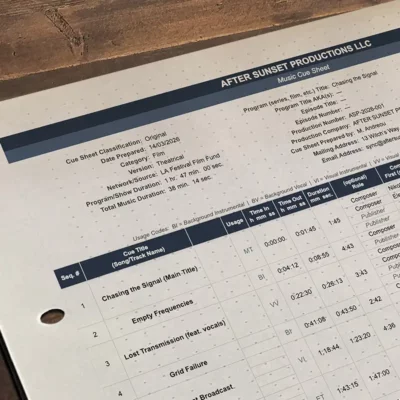
In library music, that overlap is the norm. You wrote the track. You performed it. You produced it in your DAW. You are both the songwriter and the performer on the master recording. That means every broadcast should generate two royalty streams: one on the publishing side (your PRO), one on the master side (a neighbouring rights society).
Most library composers collect only the first.
The Two Copyrights
Every commercial recording sits at the intersection of two separate copyrights.
The first protects the composition: the melody, harmony, lyrics, arrangement. This is the publishing side. It belongs to the songwriter and their publisher. It’s collected by PROs (ASCAP, BMI, PRS, GEMA, SACEM, etc.) and mechanical rights societies.
The second protects the recording: the specific performance captured on tape or in a DAW. This is the master side. The master is typically owned by whoever financed the recording: the label, the library, or the artist themselves if they self-funded. The performers who played on it hold a separate right in that same recording. Both are collected by neighbouring rights societies (PPL, GVL, SENA, AIE, SoundExchange, GRAMEX, etc.).
These two rights exist in parallel. They’re triggered by the same event, a broadcast or a public performance, but they flow through completely different channels to completely different recipients. The legal framework behind this runs deep (the Rome Convention, the WIPO treaties, EU directives), but the principle is simple: writing a song and performing a song are two different creative acts, and the law pays for both.
It’s why the royalties your PRO reports represent only the publishing side of what your broadcasts generate.
Who Gets What
Four roles, two copyrights:
Publishing side (the composition)
– Songwriter/Composer — wrote the music. Collects via PRO.
– Publisher — administers the composition. Collects via PRO + mechanical societies.
Master side (the recording)
– Featured artist/performer — the main artist on the recording. Collects via neighbouring rights society.
– Non-featured performers (session musicians) — the bass player, the drummer, the backing vocalists. They’re entitled to a smaller share, typically paid through a separate fund. In the US, SoundExchange allocates 5% of its distributions to the AFM/AFTRA fund for session players.
– Master owner (label or library) — owns or controls the recording. Collects via neighbouring rights society.
In pop music, these are usually four or more separate entities. In library music, the composer typically fills two roles (songwriter + featured performer), and the library fills the other two (publisher + master owner or exclusive licensee). If you performed everything yourself in your DAW, you’re the featured artist. No session musicians to worry about.
How This Works in a Library Deal
When your track is broadcast on, say, German television, three royalties are triggered by a single airing:
- Performance royalty (publishing side): GEMA, or your own PRO via reciprocal agreement, collects for the composition. You receive the writer’s share directly.
- Neighbouring rights royalty (master side): GVL collects for the recording. This is split between you as the performer (if you’re registered) and your library as the master owner (if they’re registered).
- Broadcast mechanical royalty (publishing side): a separate royalty triggered by the broadcaster’s act of reproducing the recording. Collected by mechanical societies and paid through your publisher. (We covered this in detail in the previous article.)
If either side of the neighbouring rights registration isn’t in place, that money accumulates unclaimed.
In many EU territories, the performer’s share of equitable remuneration is a statutory right — it’s yours by law, regardless of what your contract says. That alone makes registration worth the effort.
Your part: Register with a neighbouring rights society as a performer. Claim your participation on your recordings.
The library’s part: Register as master owner or licensee with neighbouring rights societies internationally. Maintain clean metadata so collection actually happens. Provide transparent, itemized statements.
The gap most often opens on the master side. Most libraries handle PRO and mechanical registration reasonably well. Neighbouring rights registration, especially across multiple territories, is where things fall through.
Two questions worth asking your library:
“Are you registering my recordings with neighbouring rights societies on the master side? Which territories are covered?”
If the answer is vague, that’s not a metadata issue. That’s a partner issue.
The US Exception
The US is the world’s largest music market but has the most limited neighbouring rights framework among developed nations.
What exists: A digital performance right for sound recordings, covering satellite radio (SiriusXM), internet radio (Pandora), and certain webcasters. SoundExchange administers this. (SoundExchange is not a PRO — it handles a different right entirely, so there’s no conflict with your ASCAP or BMI membership.) When your track plays on Pandora, SoundExchange collects and distributes: 45% to the featured performer, 50% to the master owner, and 5% to a fund for session musicians.
What doesn’t exist: Any performance right for sound recordings on terrestrial AM/FM radio, TV broadcasts, or public venues. When your track plays on a US radio station or US television, the broadcaster pays your PRO for the composition but pays nothing to the performer or master owner for the recording.
This is a significant anomaly. Most of Europe, Latin America, Asia, and Africa all pay neighbouring rights on terrestrial broadcasts. The US does not.
The international impact: Because the US doesn’t pay foreign performers for terrestrial broadcasts, some foreign countries historically refused to pay US performers, citing lack of reciprocity. “You don’t pay ours, so we won’t pay yours.”
That’s changing. A 2020 ruling by the Court of Justice of the EU determined that EU member states must pay equitable remuneration to performers regardless of nationality. The reciprocity argument no longer holds as a matter of EU law. Sweden began processing payments to US performers in 2025. Others are following. SoundExchange is actively signing reciprocal agreements with CMOs worldwide, and the trend is firmly in the right direction.
For US-based library composers, this means international neighbouring rights income from territories that previously withheld payment is now starting to flow.
How to Collect: A Practical Guide
This is simpler than most composers expect. It’s a one-afternoon setup, not a six-month project.
1. Register with a neighbouring rights society in your home territory. Their reciprocal agreements handle international collection. In the US, that’s SoundExchange. In the UK, PPL. In Germany, GVL. In the Netherlands, SENA.
2. Opt into international collection. This is the step most people miss. Domestic registration does not automatically cover foreign territories. If you’re with SoundExchange, log into the SX Direct portal and activate the International Services mandate. SoundExchange reports reciprocal agreements with over 90 international CMOs, covering roughly 91% of the global neighbouring rights market. You must explicitly opt in.
3. Claim your recordings. Registration alone isn’t enough. Submit your ISRC codes (the unique identifier assigned to each recording — your library can provide these) and declare your role (featured artist/performer). Your society matches your claims against broadcast logs and pays accordingly.
4. Verify your library is doing its part. Your performer registration covers your side. The library needs to register as master owner with NR societies for the other half to be collected. If they’re doing it, they’ll be able to tell you which territories and which societies.
Beyond direct society registration, there are other paths to collection.
Alternative collection services
Beyond the traditional NR societies, specialized agencies can help with multi-territory neighbouring rights collection: NRG Agency, Kollective NR, and Rightback Collections. These are worth considering if you have significant international broadcast activity and want dedicated attention beyond what a large society’s automated systems provide.
Hybrid collection societies
Most of the world still separates publishing collection from master-side collection. A few organizations handle both under one roof: ALLTRACK (Los Angeles, USA), with a quietly growing roster of high-caliber artists, has positioned itself as a single point of collection across both the publishing side (performing and mechanical rights) and the master side (neighbouring rights).
The Brazilian-based collection society UBC also collects both publishing royalties and neighbouring rights. This model is still rare, but the trend toward consolidated collection seems to be growing.
What To Do This Week
Neighbouring rights aren’t new and they aren’t obscure. They’re a fully operational royalty stream that most of the world pays and most library composers don’t collect.
The setup is straightforward:
- Check whether you’re registered with a neighbouring rights society as a performer. If not, register.
- If you’re with SoundExchange, opt into the International Services mandate. It’s not automatic.
- Claim your recordings (ISRCs, performer role).
- Ask your library whether they handle master-side NR registration internationally.
- Follow up. Look at your statements. Know what’s coming in and from where.
The music you’ve already written, already placed, already had broadcast is generating neighbouring rights royalties right now. The only question is whether anyone is collecting them on your behalf.
Further Reading
Want more on the business side of sync? Browse the After Sunset Music blog for more guides on licensing, royalties, and building a career in music for picture.